
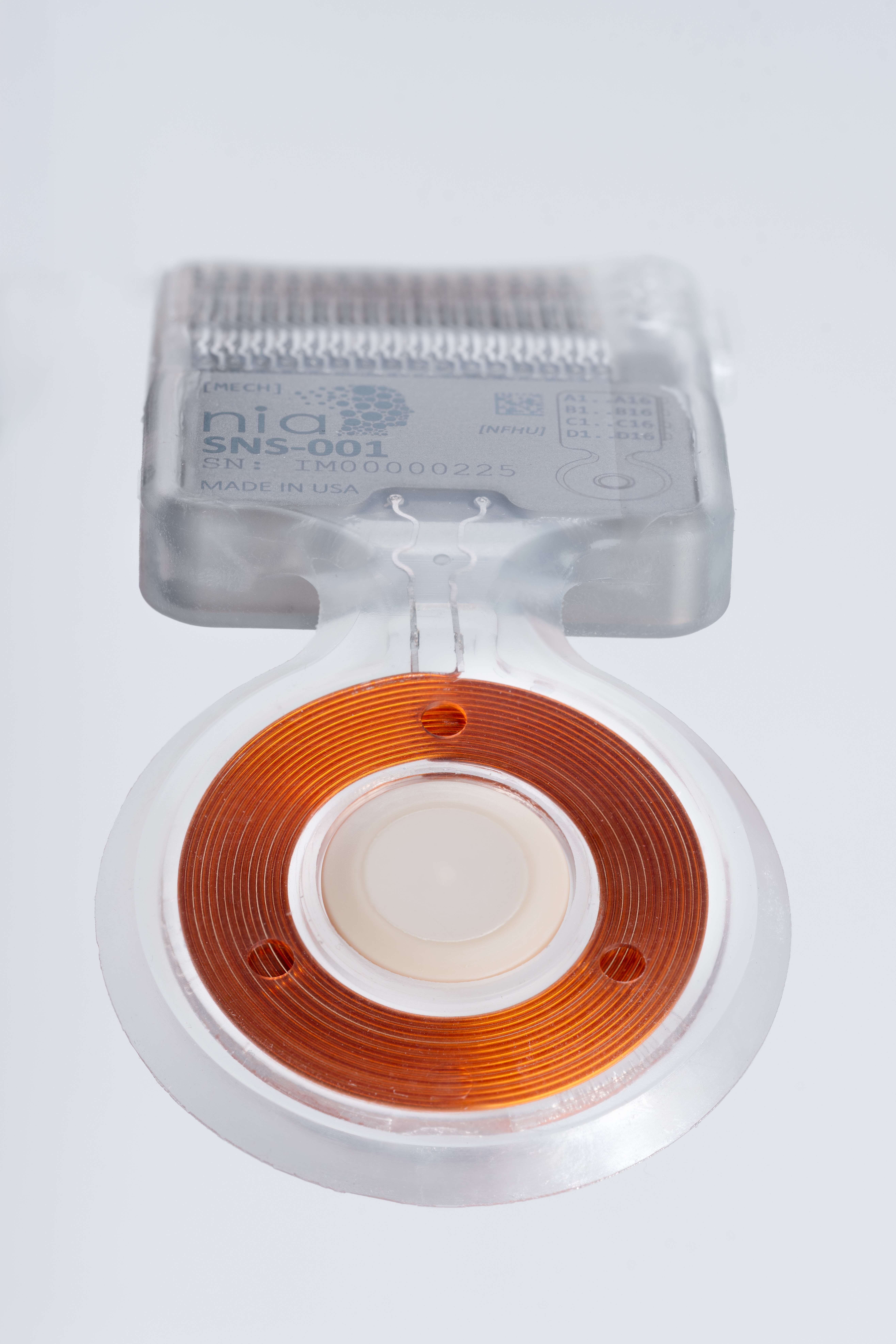
The Smart Neurostimulation System is the first neurostimulation device to receive Breakthrough designation for TBI-related memory loss; the implant decodes memory states from neural activity on 60 channels spanning four brain regions and delivers AI-guided personalized stimulation therapy to lateral temporal cortex
BOSTON–(BUSINESS WIRE)–Nia Therapeutics announced that the U.S. Food and Drug Administration has granted Breakthrough Device Designation to its Smart Neurostimulation System (SNS) for the treatment of episodic memory loss in adult patients with prior moderate-to-severe traumatic brain injury (TBI) and persistent memory deficits. The SNS is the first device to receive Breakthrough designation for TBI-related memory loss. There is significant unmet need in this indication, with no FDA-cleared or approved therapies to treat memory loss and more than 4.3 million Americans living with TBI-related disability.1
“The Breakthrough designation validates the approach we’ve spent a decade building—that memory can be improved by listening to the brain and stimulating at precisely the right moment,” said Michael Kahana, PhD, co-founder and CEO of Nia Therapeutics, and the Edmund and Louise Kahn Term Professor at the University of Pennsylvania. “This designation provides a framework to work closely with the FDA as we bring this technology from the laboratory into the clinic.”
A New Approach to Treating Memory Disorders
The SNS is a fully implantable, wireless neuromodulation platform that records neural activity from 60 channels across four brain regions. Using machine-learning classifiers trained on each patient’s own brain signals, the device detects moments of impaired memory encoding in real time and delivers targeted electrical stimulation to the lateral temporal cortex. This closed-loop approach improved recall by 19% in a randomized, sham-controlled study of neurosurgical patients with epilepsy and a history of moderate-to-severe TBI.2 Randomly timed stimulation produced no benefit, underscoring the importance of delivering therapy at the right moment.3
“Memory depends on coordinated activity across widespread brain networks—so we built a device that can sense and respond across the entire network. With 60 channels across four brain regions, the SNS offers an order of magnitude improvement over currently approved DBS devices,” said Daniel Rizzuto, PhD, co-founder and CTO of Nia Therapeutics.
Path Forward
The designation provides Nia with prioritized review, increased FDA interaction, and senior management involvement in future submissions. Building on the first in vivo validation of the SNS platform in a large-animal model, published in Brain Stimulation in 2026 (link), this designation will support the company as it advances toward an Investigational Device Exemption (IDE) application this year to support a first-in-human early feasibility study.
“Patients with TBI-related memory loss represent a profoundly underserved population,” said Dr. Ramon Diaz-Arrastia, Presidential Professor of Neurology and Director of the TBI Clinical Research Center at the University of Pennsylvania, and advisor to Nia Therapeutics. “Their disability is invisible but devastating—it affects the ability to work, maintain relationships, and live independently. We are committed to bringing them the first treatment that directly restores the capacity to form new memories.”
About Nia Therapeutics
Nia Therapeutics develops implantable brain-computer interfaces for memory disorders. Founded in 2018, the company’s SNS platform enables closed-loop neuromodulation by detecting brain states linked to impaired memory encoding and delivering targeted stimulation. Visit www.niatx.com.
Sources
- Center for Disease Control and Prevention. (2015). Report to Congress on traumatic brain injury in the United States: Epidemiology and rehabilitation (cdc:29215). https://stacks.cdc.gov/view/cdc/29215
- Kahana, M. J., Ezzyat, Y ., Wanda, P. A., Solomon, E. A., Adamovich-Zeitlin, R., Lega, B. C., Jobst, B. C., Gross, R. E., Ding, K., & Diaz-Arrastia, R. R. (2023). Biomarker-guided neuromodulation aids memory in traumatic brain injury. Brain Stimulation, 16(4), 1086–1093. https://doi.org/10.1016/j.brs.2023.07.002
- Ezzyat, Y ., Kragel, J. E., Solomon, E. A., Lega, B. C., Aronson, J. P., Jobst, B. C., Gross, R. E., Sperling, M. R., Worrell, G. A., Sheth, S. A., Wanda, P. A., Rizzuto, D. S., & Kahana, M. J. (2024). Functional and anatomical connectivity predict brain stimulation’s mnemonic effects. Cerebral Cortex, 34(1), bhad427. https://doi.org/10.1093/cercor/bhad427
Contacts
For media inquiries, contact media@niatx.com.